Introduction
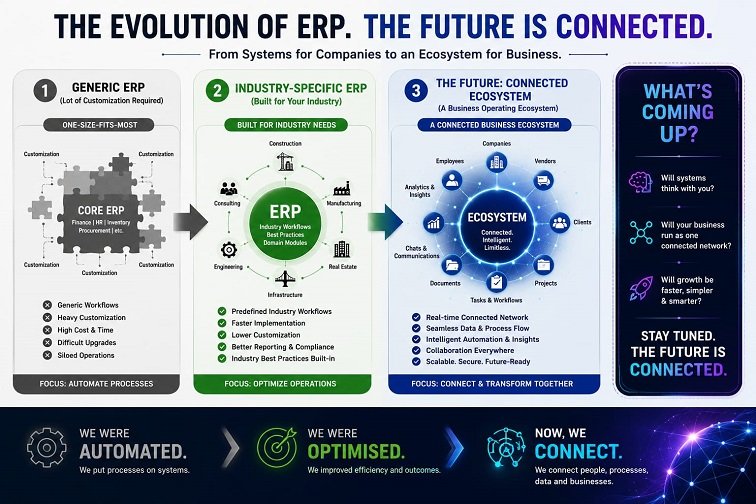
A consulting firm manages resources, deliverables, client engagements and billing cycle. A construction manager specifically manages drawings, contractors, site activities, approvals and project execution. Every industry has unique workflows, requirements, structures and priorities. Industry specific ERP were developed to address these differences, as unlike the usual ERPs that require customization, industry-specific solutions are built around sector specific processes, hence which allows organizations to implement them faster, reduce customization costs, improve user experience and achieve better operational efficiency.
Although this has been a significant step forward in the digital transformation journey, business operations have evolved much faster than enterprise software.
Today an organization operates in an environment where speed, collaboration, data driven decisions, and customer experiences have become important as much as operational efficiency. Businesses can’t just depend on a single software to run their operations but instead relies on dozens of specialized applications to manage different aspects of the business. Customer relationship is managed through CRM platforms, Employee lifecycle and payroll are handled through HRMS solutions. Business intelligence tools generate insights and dashboards. Communication is done by other applications.
The challenge that occurs is that all these applications often function independently. While an industry specific ERP successfully manages transactions and operational records, valuable information. Teams still frequently have to move between different platforms to collect data, communicate with stakeholders or complete approvals. As the number of softwares increases, so does the complexity of managing them.
This is not a technology issue but a lack of connectivity issue.
When information exists in isolated systems, organizations lose the ability to make quick and informed decisions. Employees spend time searching for information, transfer data from one app to another, slowing down decision making, collaboration becomes fragmented and operational efficiency begins to decline despite the investment in technology.
This is why the conversation shifts from ERP implementation towards the need for connected business ecosystems.
The business ecosystem should not be viewed as another standalone application. It should be an integrated digital environment where ERP works alongside CRM, HRM, communication platforms, document management, workflow automation and other services as a single connected framework.
Instead of creating multiple sources of information, such a connected ecosystem should be something that connects every application to contribute to a single operational unit.
Imagine an environment where customer inquiry could automatically create a project opportunity within CRM, generate project workflows inside ERP, assign roles through task management platforms, store data at the center repository, trigger automated approvals, and update dashboard in real time. Such integration could significantly remove repetition of manual work hence improving visibility too across organization.
Artificial intelligence has the potential to make such systems even more powerful, it could monitor workflow, answer queries and assist managers in making better decisions. Similarly automation could eliminate routine administrative activities that consumes employee time. Workflows can trigger approvals, assign tasks, send reminders and update the system.
Cloud technology can further strengthen such an ecosystem more by allowing secure access to business information from anywhere while enabling collaboration across geographically distributed teams. The true value does not lie in ensuring all technology works but rather that all technology works together.
This is why scalability and interpretability have become critical considerations for business planning future digital investments. Organizations should not simply evaluate if the ERP works but rather whether it can integrate with future technologies, support new business models, connect with external applications and evolve as requirements change.
Digital transformation is just not about purchasing software anymore.
The next phase of digital transformation should focus on creating an intelligent ecosystem where data flows seamlessly, communication remains connected, workflows are automated, and AI enhances decision making.
Industry specific ERP solutions might remain the operational foundation for business because they understand industry requirements, but the future belongs to those that build connected ecosystems around that foundation.
ERP remains the foundation. Connected Ecosystems is what will define the next generation.
(The author is Kailash Anwala, Founder and Managing Director, UniSteps Consulting Pvt. Ltd., and the views expressed in this article are his own)