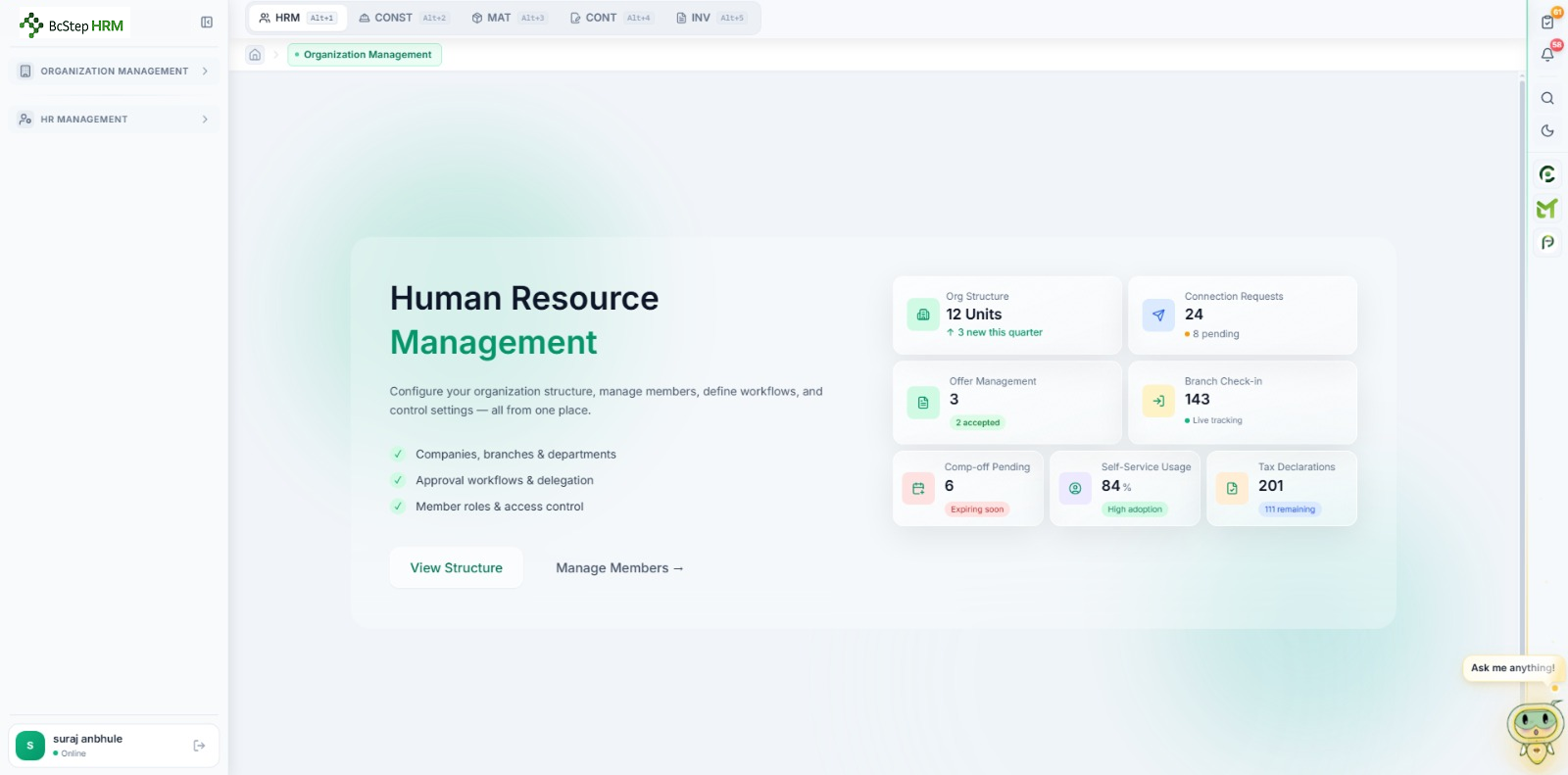
Instead of employee information being scattered across HR files, spreadsheets and individual records, BcStep HRM creates a structured digital history that can remain accessible to authorized personnel throughout the employee lifecycle.
BcStep HRM
Workforce Intelligence
Managing people is not simply about knowing who is present, who is absent, and how much salary to pay.
Organizations need to understand how their workforce actually operates—where employees work, how consistently they perform, what they contribute, how they coordinate, and how their employment journey evolves over time.
BcStep HRM brings these dimensions together.
From attendance, leave and payroll to employee records, work behaviour, salary structures, policies and workforce insights, BcStep HRM creates a connected digital record of the employee and their work journey.
And because BcStep HRM is part of the BcStep Business Operating Network, workforce information does not remain isolated from the organization's Chat, Email, Task Management and ERP activities.
Track attendance and working hours across employees.
Manage leave requests, balances and approvals.
Manage payroll and salary processing accurately.
Centralize employee profiles, documents and history.
Understand productivity, patterns and behaviour.
Create flexible salary structures and components.
Maintain HR policies, compliance and rules.
Turn workforce data into actionable insights.
Traditional attendance systems primarily answer one question:
BcStep HRM goes considerably deeper.
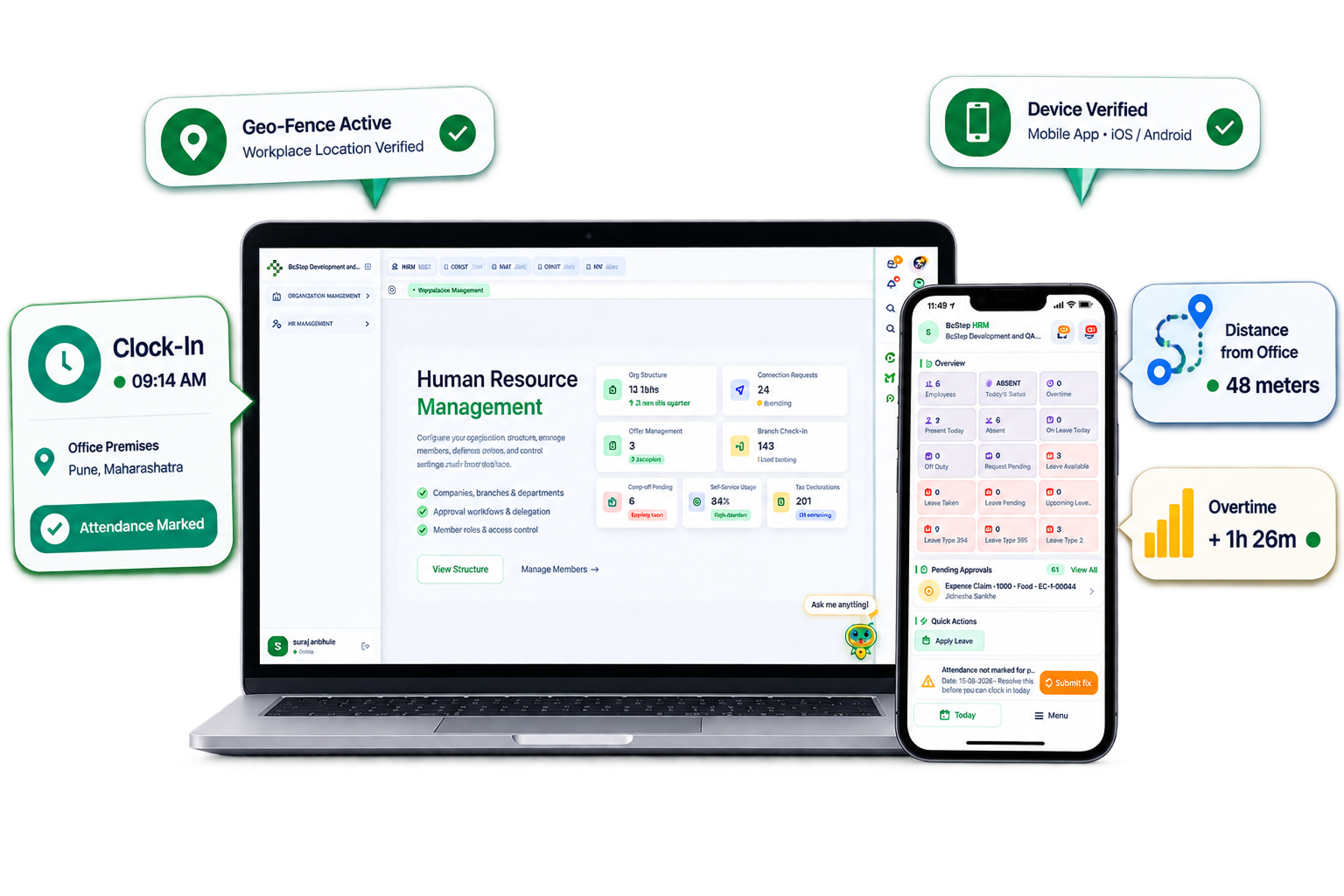
Its attendance system can capture location-based attendance, geo-fencing, location movement, altitude, device and workplace-related information , helping organizations establish a more reliable picture of where and when employees are working.
Attendance can be governed through configurable organizational policies covering:
This allows attendance policies to reflect the organization's actual working practices rather than forcing every organization into a standard attendance model.
TIME + LOCATION + MOVEMENT
to provide a deeper view of workforce attendance.
BcStep HRM's attendance approach goes beyond simply recording time.
TIME + LOCATION + MOVEMENT
to provide a deeper view of workforce attendance.
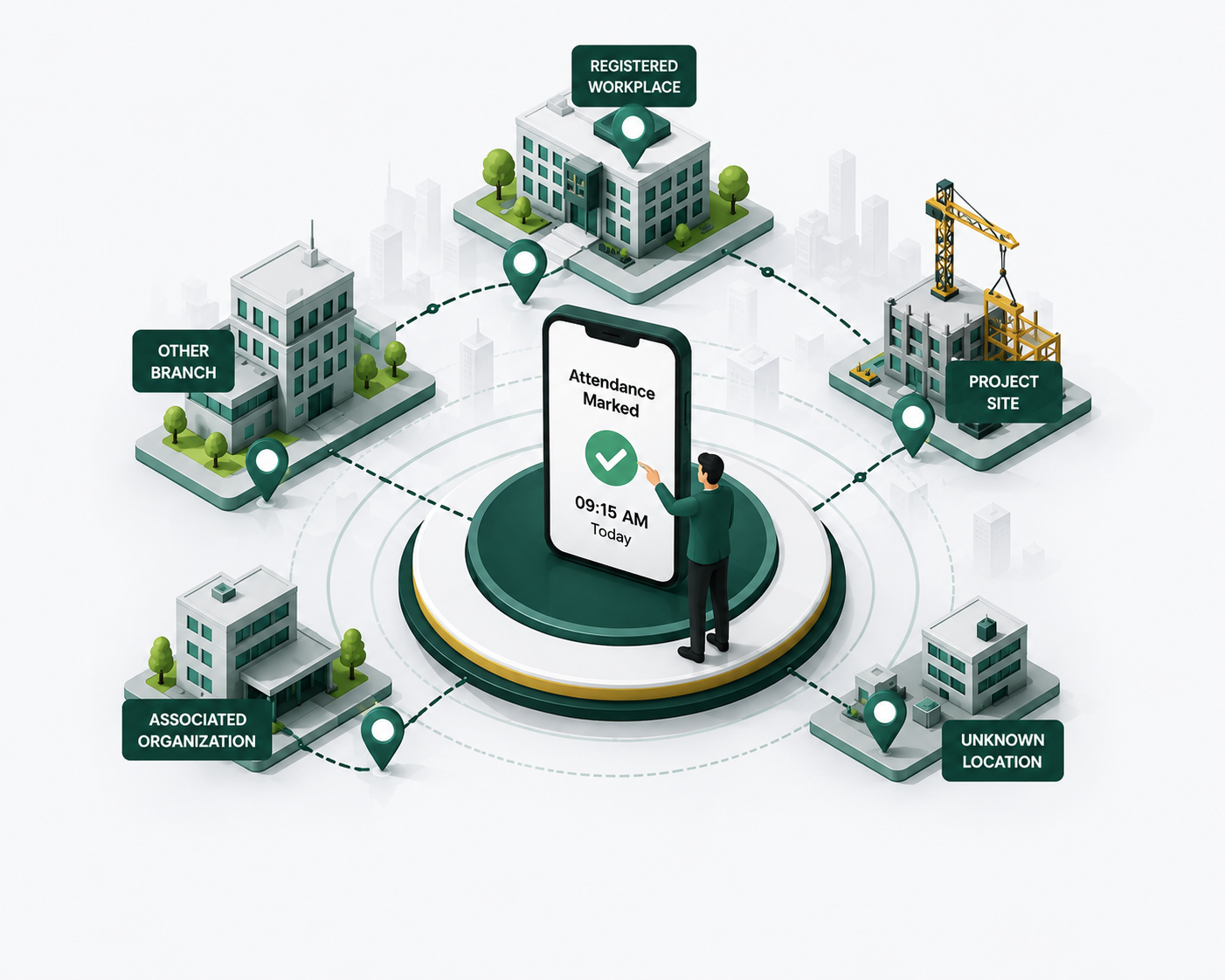
Because BcStep HRM operates within the BcStep BON, attendance can also provide visibility into where an employee is actually marking attendance.
For organizations connected with multiple branches, project sites or associated organizations, the system can even identify whether attendance was marked from:
This gives management greater transparency into both attendance location and working-hour movement.
BcStep can also provide visibility into why a Time-Trail may not have been available—for example, due to network unavailability, location being switched off, or mobile data being unavailable.
So the system does not simply record the attendance result.
Leave management in BcStep HRM is policy-driven rather than simply a leave calendar.
Organizations can define how leave behaves during probation, how different leave categories are accounted for, and how excess leave requests should be treated.
BcStep HRM also gives senior management the flexibility to reclassify an applied leave into the appropriate leave category while approving it. This means HR or Accounts does not need to repeatedly clarify or reclassify leave entries while processing payroll.
This ensures that attendance, leave policies, leave approvals and payroll are connected rather than managed as separate processes.
Payroll becomes more reliable when the information feeding it is already structured.
Salary structures can be assigned based on organizational requirements, including the employee's Workplace, Primary Reporting Office, Overtime Policy, Probationary Leave Policies and Joining Date.
The system also supports controlled salary-generation workflows, including a defined window for making changes to generated salary information.
This helps reduce repetitive manual reconciliation between HR records, attendance data and payroll processing.
Because BcStep HRM is connected to the wider BcStep BON, it goes beyond traditional attendance management to create background visibility into employee work behaviour and involvement.
Employees' activities across the BcStep ecosystem can contribute to a broader understanding of their work.
Instead of performance visibility depending entirely on what a senior remembers or reports, organizations can increasingly understand employee contribution through recorded work activities.
This can help management recognize genuine performers whose work might otherwise remain unnoticed—and help organizations avoid losing valuable employees simply because their contribution was not sufficiently visible.
BcStep HRM maintains a structured employee record covering important aspects of the employee's organizational journey.
Instead of employee information being scattered across HR files, spreadsheets and individual records, BcStep HRM creates a structured digital history.
Instead of employee information being scattered across HR files, spreadsheets and individual records, BcStep HRM creates a structured digital history that can remain accessible to authorized personnel throughout the employee lifecycle.
The employee's complete history remains available to the organization, allowing management to make informed decisions based on their previous tenure.
If Senior Management has marked an employee as not eligible for rejoining, BcStep HRM can prevent HR or Accounts from inadvertently reconnecting that employee with the organization—even if the employee applies at another branch or location.
When an employee exits the organization, BcStep HRM can automatically create a BcStep Profile containing relevant information from their organizational journey.